Enabling Retrofit
A case study by Ben Walsham, ARKATA, in collaboration with Tom Petty, builder at Petty Projects, and Co-Founder of CarbonTrace.
The Project
I met Tom Petty through an Australian Institute of Architects working group called “AU 2050 Carbon Cooperative”.
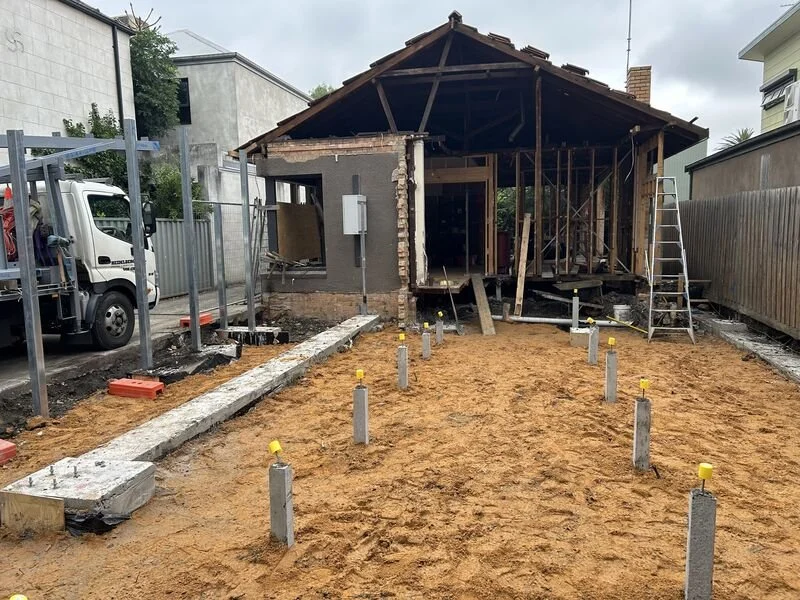
Tom engaged ARKATA to become the NatHERS partner for a Victorian alteration and addition project. The northern aspect of the home was proposed to be rebuilt, while the southern part was proposed to be retrofitted.
The home itself had several impressive features at the outset. It was proposed to salvage and re-use existing materials from the northern demolition, where bricks would be re-used for the proposed reverse brick veneer walls. Lightweight foundations were proposed with minimal reliance on new concrete pours, where the existing piles would be re-used for the new suspended timber floor.
This was a project where carbon consciousness and thermal performance were goals from the start, not bolted on at the end.
ARKATA’s Role
Our role was to develop the energy efficiency strategy, where optimisation of thermal performance happened alongside understanding cost and carbon implications. We were to provide the data that enables Tom to make informed decisions about where performance and carbon intersect.
The Baseline
The project is a typically old Victorian home that is draughty, cold, and vulnerable to consistently high energy usage through all periods of the year.
The home started at an existing, pre-renovated Star Rating of 2.5 Stars, with heating loads at 207 MJ per m2 per year.
This house was leaky, sitting at a considerable NatHERS-calculated air leakage rate of 80+ air changes per hour at 50 Pascals.
The proposed scope of renovation works moved this initial Star Rating from 2.5 Stars to 6.9 Stars.
| Star Rating | Heating Load (MJ/m².yr) | Cooling Load (MJ/m².yr) | Total Load (MJ/m².yr) | Reduction | |
|---|---|---|---|---|---|
| Existing |
2.5 | 207.6 | 29.7 | 237.3 | — |
| Proposed >10 ACH@50pa |
6.9 | 49.8 | 13.8 | 63.6 | -73.2% |
The Optimisation Map
| Potential Upgrades | Star Rating | Total Load (MJ/m².yr) | Load Reduction | Carbon Implications |
|---|---|---|---|---|
| R2.0 insulation to existing suspended timber floors | 6.9 → 7.4 | 63.6 → 52.6 | -17.3% | Minimal — into existing structure |
| Replace existing windows with high-performance uPVC (Avg. U-Value 1.9) | 6.9 → 7.4 | 63.6 → 54.5 | -14.3% | High — new manufacturing, disposal |
| Increase ceiling insulation to R6.0 | 6.9 → 6.9 | 63.6 → 62.6 | -1.6% | Low — additive to existing |
| Reduce existing window to 1800mm wide | 6.9 → 7.1 | 63.6 → 60.8 | -4.4% | High — new manufacturing + infill |
| Target airtightness of 5.0 ACH@50pa | 6.9 → 7.3 | 63.6 → 55.6 | -12.6% | Low to Medium — some new infill to air seal |
The Carbon Lens
Tom didn’t implement everything that was possible, because when we begin to think about carbon consciously, the upgrades we take on become obvious.
Underfloor insulation alone moves the home from 6.9 Stars to 7.4 Stars with minimal impact to the home’s overall carbon footprint.
Further to this simple intervention, Tom was keen to air seal and minimise air leakage, which as shown in the table above, provides a considerable thermal improvement with low carbon impact.
The Outcome
This process gave Tom a clear map: where the home could go thermally, and what each move costs in carbon terms. When those two dimensions are overlaid, a sweet spot emerges: high-performance, low carbon impact, informed by data.
The end results:
Tom’s Words
Working with Ben was a great process, he has very well developed systems to communicate performance options, a smooth client-side experience and helped to deliver the project with the right balance of performance and cost.
The Site’s Evolution
Image Source: “Why don’t you just push it over?” — Tom Petty (LinkedIn)